Computers, smartphones, servers, and other machines constantly exchange information in today’s connected world. But how does this data get from one device to the other? It is answer number transmission media in computer networks.
Media of transmission – the means that is used to send information, signs, and data from one device to another, or from one device to more than one. It is an important aspect of networking because the speed, reliability, security, and distance of communication are strongly influenced by the nature of the medium used.
To put it simply, the media of transmission is the road that data travels along. Digital data, like vehicles, requires a medium through which it can move between devices in a network.
This article will describe the types of transmission media, its application, pros, cons and practical application examples in simple terms.
Also Read:- MAN Full Form in Computer: What Is a MAN Network? Meaning, Examples & Uses
What is transmission media in a computer network?
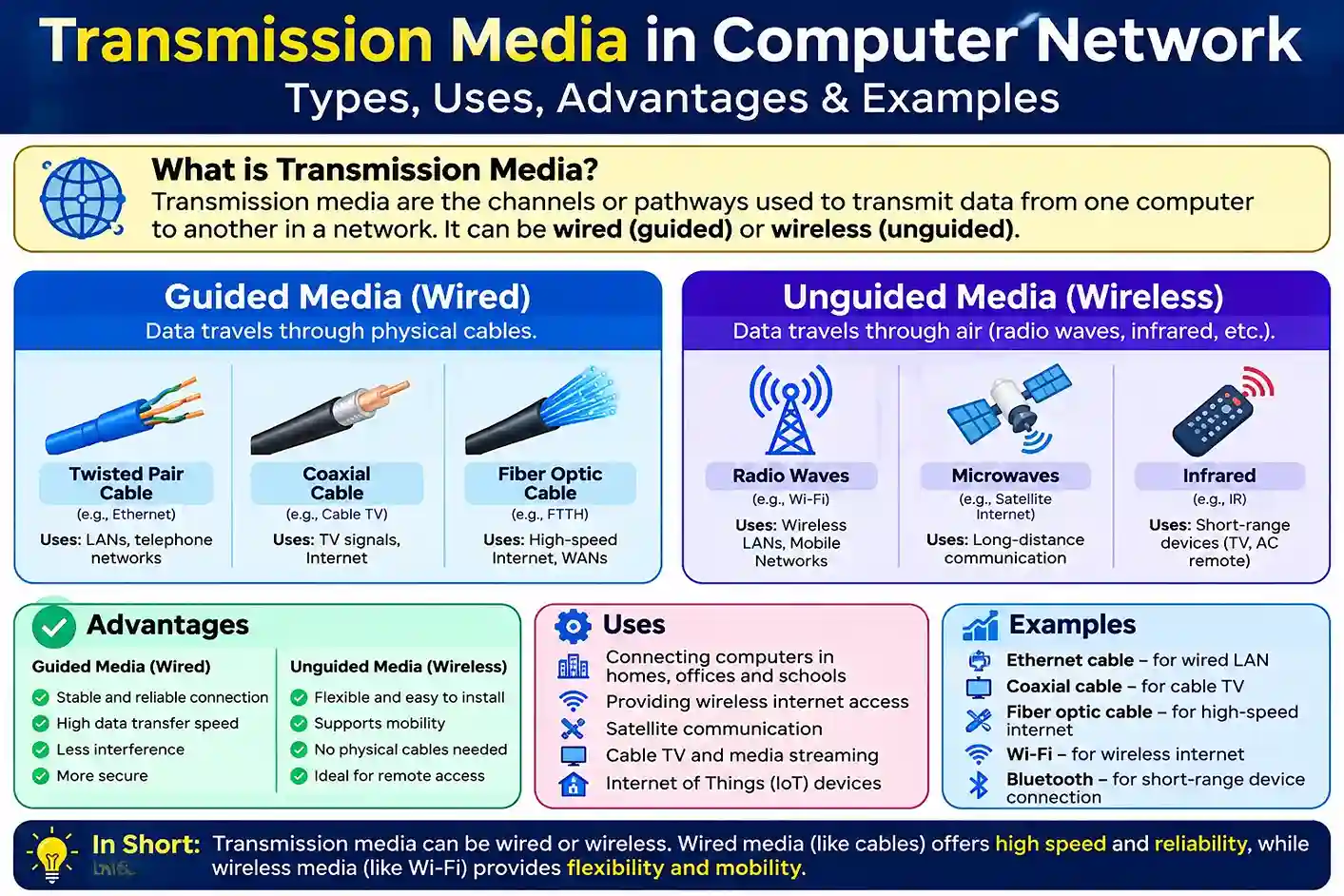
“Transmission media” in a computer network refers to the physical or wireless communication channel used to transfer data from one device to another.
For example, when you connect a computer to the internet using an Ethernet cable, the cable acts as transmission media. Similarly, Wi-Fi uses radio waves to send data without a physical cable.
Transmission media is mainly divided into two categories:
- Guided Transmission Media
- Unguided Transmission Media
Let’s understand both in detail.
Types of Transmission Media
1. Guided Transmission Media
Guided transmission media uses a physical path, such as a cable or wire, to transmit data. The signals travel through the physical medium.
The main types include:
- Twisted Pair Cable
- Coaxial Cable
- Fiber Optic Cable
Twisted Pair Cable
A twisted-pair cable consists of two insulated copper wires twisted around each other. The twisting helps reduce electromagnetic interference and improves signal quality.
There are two common types:
- UTP (Unshielded Twisted Pair)
- STP (Shielded Twisted Pair)
UTP is widely used in computer networks because it is affordable and easy to install. STP has additional shielding, which provides better protection against interference.
Uses:
- Local Area Networks (LANs)
- Telephone connections
- Ethernet networks
- Office and home networking
Advantages:
- Low cost
- Easy to install
- Flexible
- Widely available
Disadvantages:
- Limited transmission distance
- More affected by interference than fiber optic cable
- Lower bandwidth compared with modern fiber connections
Example: The Ethernet cable commonly used to connect a computer to a router is usually a type of twisted pair cable.
Coaxial Cable
Coaxial cable contains a central copper conductor surrounded by insulation, a metallic shield, and an outer protective covering.
It was commonly used in older computer networks and is still used in applications such as cable television and broadband internet connections.
Uses:
- Cable TV
- Broadband internet
- CCTV systems
- Some communication networks
Advantages:
- Better protection from interference than basic twisted-pair cable
- Strong and durable
- Can carry signals over relatively long distances
Disadvantages:
- Thicker than twisted-pair cable
- Less flexible
- Installation can be more difficult
Example: The cable used for a traditional cable TV connection is a common example of coaxial cable.
Fiber Optic Cable
Fiber optic cable is one of the fastest transmission media available today. Instead of electrical signals, it uses pulses of light to transmit data through thin strands of glass or plastic.
Because it uses light, fiber optic cable can provide very high bandwidth and can transmit data over long distances.
There are two major types:
- Single-mode fiber
- Multimode fiber
Uses:
- High-speed internet
- Data centers
- Long-distance communication
- Telecommunication networks
- Undersea internet cables
Advantages:
- Very high speed
- High bandwidth
- Supports long-distance communication
- Resistant to electromagnetic interference
- Better security against certain types of signal interception
Disadvantages:
- More expensive than copper cables
- Installation can require specialized equipment
- Fiber can be more delicate during handling
Example: Internet service providers commonly use fiber optic cables to deliver high-speed broadband connections.
2. Unguided Transmission Media
Unguided transmission media does not require a physical cable. Instead, data travels through air or space using electromagnetic waves.
Common examples include:
- Radio waves
- Microwaves
- Infrared
- Satellite communication
Radio Waves
Radio waves are widely used for wireless communication. They can travel through the air and, depending on the frequency and environment, can cover considerable distances.
Uses:
- Wi-Fi
- Bluetooth
- Radio communication
- Mobile communication
- Wireless networking
Advantages:
- No physical cables are required
- Easy to deploy
- Useful for mobile devices
- Can cover large areas
Disadvantages:
- Can experience interference
- Security can be a concern if communication is not properly protected
- Signal quality may be affected by obstacles and environmental conditions
Example: Wi-Fi routers use radio waves to communicate with smartphones, laptops, and other wireless devices.
Microwaves
Microwave communication uses high-frequency electromagnetic waves to transmit information. It is often used for point-to-point communication and long-distance wireless links.
Microwave systems can use terrestrial towers or satellites.
Uses:
- Mobile communication networks
- Television transmission
- Long-distance telephone communication
- Internet backhaul
- Communication between network towers
Advantages:
- Supports long-distance communication
- Does not require cables between transmission points
- Can provide high data rates
Disadvantages:
- Often requires a clear line of sight
- Weather conditions can affect some microwave links
- Installation of towers can be expensive
Example: Communication between two telecom towers can use a microwave link.
Infrared
Infrared transmission uses infrared light to send information over short distances. It generally requires the devices to be relatively close to each other.
Uses:
- Remote controls
- Short-range device communication
- Some sensors and specialized communication systems
Advantages:
- Low interference with radio systems
- Useful for short-distance communication
- Relatively simple technology
Disadvantages:
- Short range
- Usually cannot pass through walls
- Requires a suitable path between devices
Example: A television remote control uses infrared signals to communicate with a TV.
Satellite Communication
Satellite communication uses satellites orbiting Earth to receive and retransmit signals. It is especially useful when traditional wired or terrestrial wireless infrastructure is difficult to deploy.
Uses:
- Satellite internet
- Television broadcasting
- Navigation systems
- Remote-area communication
- Disaster and emergency communication
Advantages:
- Can cover very large geographical areas
- Useful in remote locations
- Does not require a direct physical cable between distant locations
Disadvantages:
- Expensive infrastructure
- Some satellite systems can have noticeable communication delay
- Weather can affect certain satellite signals
Example: Satellite internet can provide connectivity to areas where fiber or other terrestrial networks are unavailable.
Guided vs Unguided Transmission Media
| Feature | Guided Media | Unguided Media |
| Physical cable | Required | Not required |
| Signal path | Through a cable | Through air or space |
| Examples | Twisted pair, coaxial, fiber | Radio, microwave, satellite |
| Mobility | Limited | High |
| Installation | Requires cabling | Often easier in difficult locations |
| Interference | Depends on cable type | Can be more vulnerable to interference |
| Common use | LANs, data centers, broadband | Wi-Fi, mobile networks, satellite |
Uses of Transmission Media in Computer Networks
Transmission media is used in almost every type of network. Some common applications include:
1. Internet Connectivity
Fiber optic cables, wireless signals, and other media help connect users to internet services.
2. Local Area Networks
Ethernet cables are commonly used to connect computers, printers, switches, and routers within homes, schools, and offices.
3. Mobile Communication
Wireless radio technologies allow smartphones and other mobile devices to communicate with cellular networks.
4. Data Centers
High-speed fiber connections are widely used inside and between data centers to support large amounts of data traffic.
5. Long-Distance Communication
Fiber optic cables, microwave links, and satellites help transfer information across cities, countries, and even continents.
Advantages of Transmission Media
Choosing the right transmission medium can provide several benefits:
- Faster data transfer: High-quality media can support high-speed communication.
- Reliable communication: A suitable medium can reduce signal loss and connection problems.
- Long-distance transmission: Fiber and wireless technologies can support communication across long distances.
- Better connectivity: Transmission media allows multiple devices to communicate efficiently.
- Flexible networking: Wireless media makes it easier to connect mobile devices and locations where cables are difficult to install.
Disadvantages of Transmission Media
Every transmission medium has some limitations:
- Cable-based systems can require significant installation work.
- Wireless signals can face interference.
- Some high-speed media can be expensive.
- Signal quality may decrease over long distances.
- Physical cables can be damaged.
- Wireless networks require appropriate security measures.
How to Choose the Right Transmission Media?
There is no single transmission medium that is best for every situation. The choice depends on several factors.
1. Distance: For very long distances, fiber optic cable or wireless technologies may be suitable.
2. Speed: If high bandwidth is required, fiber optic cable is often a strong choice.
3. Cost: Twisted pair cable is generally more affordable for many small networks.
4. Environment: Wireless transmission can be useful where installing cables is difficult.
5. Security: Wired connections can offer advantages in controlled environments, while wireless networks need proper encryption and access controls.
6. Installation: The available infrastructure and installation requirements should also be considered.
Transmission Media Examples in Daily Life
You probably use transmission media every day without thinking about it.
- Ethernet cable: Connects a PC or smart TV to a router.
- Fiber optic cable: Provides high-speed broadband internet.
- Wi-Fi: Connects phones and laptops wirelessly.
- Bluetooth: Connects devices such as headphones and keyboards.
- Satellite: Provides communication and internet services in remote areas.
- Coaxial cable: Used for cable TV and some broadband connections.
- Infrared: Used in many traditional TV remote controls.
Conclusion
In computer network, transmission media is a way by which data can be transferred from one device to another. Whether it’s a wired or wireless network, it’s a fundamental and crucial component of networking.
Guided media, like twisted pair, coax and fiber optic cables, gives a physical channel for the signals. Unguided media: The signals are carried in the air or on satellites, for example, radio waves, microwaves, and infrared.
The selection of the right one depends on the factors like speed, distance, cost, security, reliability, and installation requirement. Knowing about these types allows the understanding of computer networks and the internet easier in everyday life.
Frequently Asked Questions (FAQs)
Transmission media in computer network is the communication path used to transfer data between two or more devices. It can be wired or wireless.
There are two main types: guided transmission media and unguided transmission media. Guided media uses cables, while unguided media uses wireless signals.
Common examples include twisted pair cable, coaxial cable, and fiber optic cable.
Radio waves, microwaves, infrared, and satellite communication are common examples of unguided transmission media.
Fiber optic cable is generally considered one of the fastest transmission media because it provides very high bandwidth and uses light to transmit data.
Guided media sends signals through a physical cable, while unguided media sends signals wirelessly through air or space.
Transmission media provides the path through which information travels between network devices. Its characteristics affect network speed, reliability, distance, and overall performance.
Twisted pair Ethernet cable is commonly used in wired LANs because it is affordable, easy to install, and suitable for typical network connections.
Yes. Wi-Fi uses radio waves as a wireless transmission method to transfer data between devices.